



| Membership | Price (+HST) |
|---|---|
| Single | $85/year |
| Single Plus | $120/year |
| Family | $130/year |
| Family Plus | $175/year |
| Contributing | $300/year |
| Supporting | $600/year |
| Sustaining | $1,000/year |
| Benefactor's Circle | $2,500/year |
| Director's Circle | $5,000/year |
| President's Circle | $10,000/year |

Helping Save the Forest’s Air Conditioner: Eastern Hemlock
February 24, 2026
By Mallory Peirce, Senior Terrestrial Ecologist, Royal Botanical Gardens
Eastern Hemlock (Tsuga canadensis) is the forest’s elder – standing tall, casting deep shade that turns hot summer air into a cherished refuge. When you find yourself amongst hemlocks, the world appears slower and calmer. Their presence casts steadiness, persistence, and confidence, as if they’ve been holding the forest together – offering shade and shelter from the harshness of life in the natural world.
Stewardship involves responsible management, care, and oversight of items entrusted to one’s care, with the primary goal of long-term protection. Protecting Eastern Hemlock is a prime example of ecological stewardship at Royal Botanical Gardens (RBG). This long-lived conifer provides vital year-round shade, stabilizes slopes, and helps keep streams cool making it a significant keystone species in Southern Ontario forests. Invasive Species are a principal threat to biodiversity with the Ontario Invasive Species Centre a hub for information. When Eastern Hemlock is threatened by the invasive Hemlock Woolly Adelgid (Adelges tsugae; hereafter HWA), its decline and loss disrupt ecosystem function, with consequences far greater than the death of individual trees.
RBG has been slowing the spread of HWA throughout its nature sanctuaries, and throughout the rest of Southern Ontario, since it was first detected along Caleb’s Walk in 2023. As an organization, the first question that we did not have the answer to was “How many Eastern Hemlocks are in our nature sanctuaries?”. We needed to know the scale at which this new invasive species would impact on our forests and how much it would cost for HWA control treatments.
The earliest inventory completed for RBG on Eastern Hemlock was conducted by Dr. Harold A. Senn in 1932-33. Dr. Senn was contracted by the Board of Parks Management to survey trees in “Royal Botanical Gardens”, which took place in the area adjacent to what is now Churchill Park, in Westdale. During his inventory, Dr. Senn inventoried 300 trees of 24 various species. Eastern Hemlock accounted for 3% of the total trees inventoried. Other historical inventory information was data from another tree inventory completed in 1972 by RBG’s Conservationist and Coordinator of Education, John Lamoureux. Lamoureux’s inventory findings can be found in the table below. Despite Lamoureux’s in-depth inventory, we needed an up-to-date inventory of hemlocks across RBG’s nature sanctuaries.
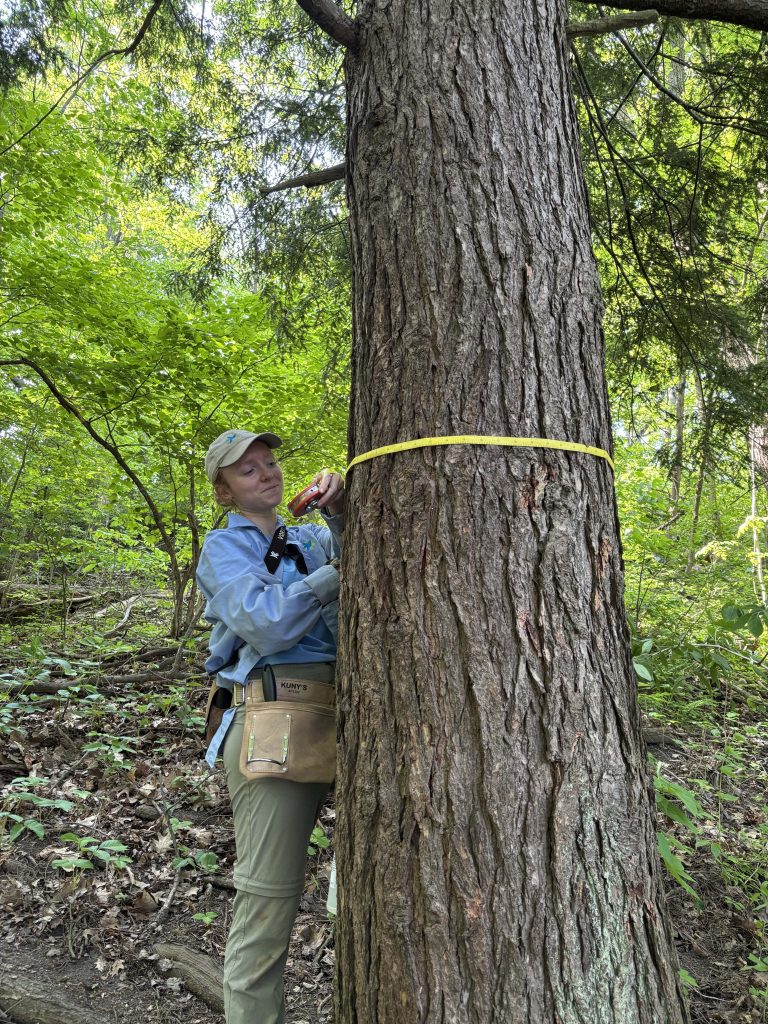
In the summer of 2024, RBG’s Terrestrial Ecology Team completed Eastern Hemlock surveys across the South Shore of Cootes Paradise. There were three key pieces of information that resulted from these surveys: total number of hemlocks, each tree’s size, and the extent of spread of HWA through our hemlock stands. Last summer, the rest of the nature sanctuaries were inventoried for Eastern Hemlock. The following table highlights the number of hemlocks in each nature sanctuary, and the percentage of trees infested with HWA. The average size of the hemlocks surveyed was 60.8cm diameter-at-breast-height (DBH).
The South Shore of Cootes Paradise and the slope surrounding RBG’s Rock Garden are completely infested with HWA, and nearly 70% of trees on the North Shore of Cootes Paradise area infested. The nature sanctuaries that remain HWA-free include Rock Chapel (where there is one lone Eastern Hemlock) and Hendrie Valley. Annual monitoring of stands will continue to either update infestation intensity status or detect a new infestation (at either Rock Chapel or in Hendrie Valley).
| Location | Lamoureux Population Study (1972) | Eastern Hemlock Inventory (2024-25) | % Trees Infested with HWA | %Trees Not Yet Infested with HWA |
| South Shore | 782 | 628 | 100% | 0% |
| North Shore | 413 | 377 | 68% | 32% |
| Rock Garden Slope | N/A | 198 | 100% | 0% |
| Hendrie Valley | 314 | 170 | 0% | 100% |
| Rock Chapel | 72 | 1 | 0% | 100% |
| Total Number of Trees in RBG’s Nature Sanctuaries | 1,581 | 1,374 | 79% | 21% |
*Note: It is unclear if Lamoureux’s survey of Hendrie Valley included the edge of the Rock Garden slope, which might account for the dramatic difference in number of trees inventoried.
**Note: The dramatic difference between Lamoureux’s hemlock inventory at Rock Chapel might be explained by accurately mapping property borders since the 1970s.
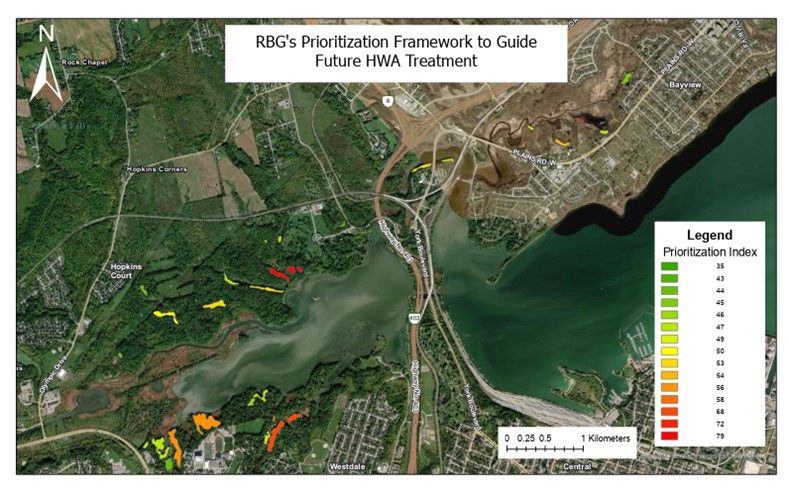
The data from the hemlock inventory surveys is instrumental in prioritizing hemlock sands for treatment, as RBG implements calculated stewardship actions. To help guide Eastern Hemlock protection at RBG, an adapted Prioritization Framework (from the New York State Hemlock Initiative) has been mapped and implemented. The map highlights which hemlock stands, based on certain landscape characteristics, presence or absence of HWA, and hemlock health, should be prioritized for chemical treatment.
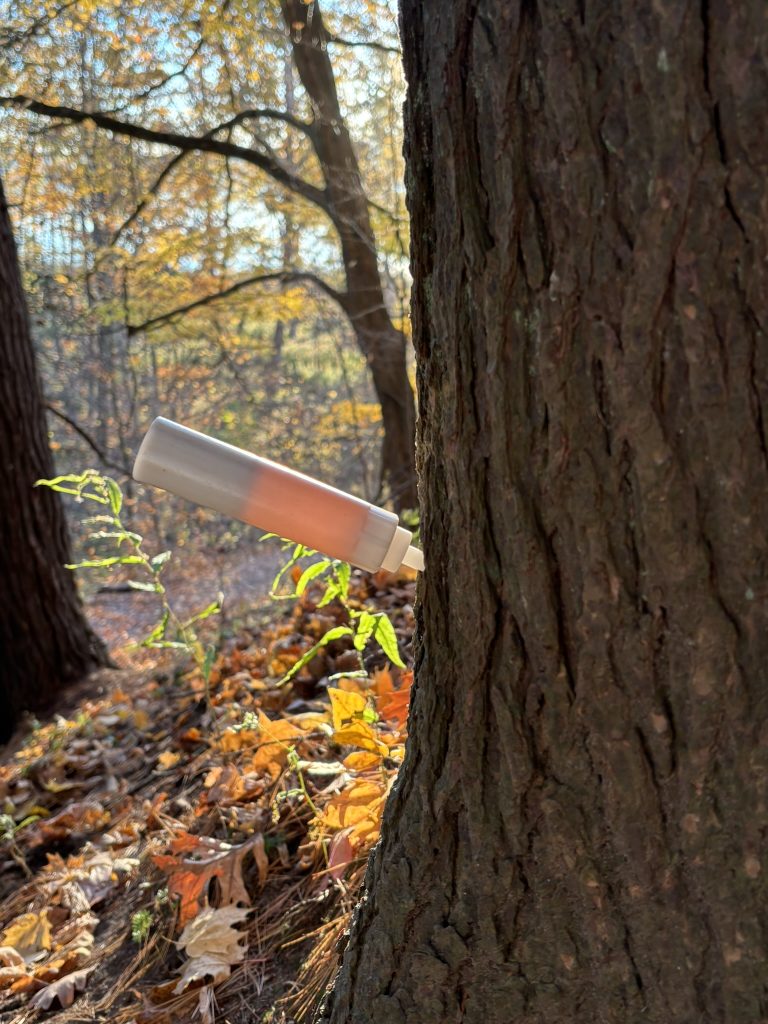
To date, RBG has provided temporary protection to 227 Eastern Hemlocks using TreeAzin, which is a botanically derived pesticide used to combat HWA. This treatment is expensive, and unfortunately, temporary, as protection from HWA only lasts for two years. Therefore, follow-up treatments are required to keep the pest at bay.
Follow-up health assessments on treated trees will occur this summer, to ensure the trees are responding well to treatment. More treatments are planned for November 2026, with the goal of protecting upwards of 100 more hemlocks.
RBG continues to collaborate with local stakeholders, including the City of Hamilton, Hamilton Naturalists’ Club, McMaster University, and Hamilton Conservation Authority, all of whom are battling HWA on their respective properties. Battling forest pests is truly a collaborative effort. Knowledge-sharing has been the key to local success in HWA management.
What can you do to help protect Eastern Hemlocks?
- Do not move Eastern Hemlock material (branches, logs, or twigs) from Hamilton, as this is a Regulated Area, as per the rules outlined by the Canadian Food Inspection Agency.
- Stay on marked trails and decontaminate your clothes (lint roll and wash) when you return home from a hike. Trail users pose a threat to inadvertently spread HWA to uninfected areas (like the Muskoka region).
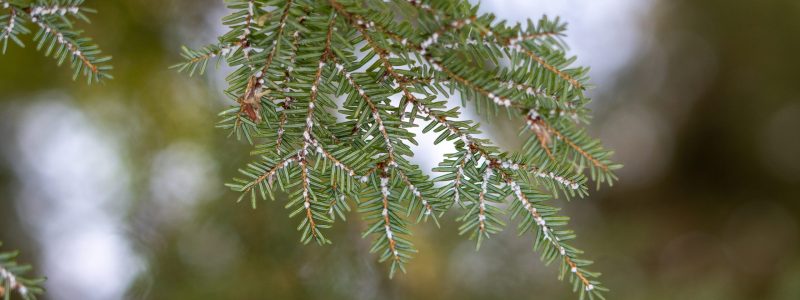
- Learn how to identify HWA, and keep your eyes peeled when you’re hiking. You never know what you might see. The more eyes looking for a new pest, the sooner landowners can take action to protect their trees!
- If you have an Eastern Hemlock on your property, conduct visual inspections for woolly sacs on the underside of branches from January through June.
- Remove bird feeders that are set up close to hemlocks. Birds are the main mechanism of spread for HWA. Therefore, attracting birds to perch on hemlocks near feeders could inadvertently spread HWA.
The next time you find yourself beneath the dense canopy of a hemlock in summer, take note of how the air feels cooler and the fresh scent of evergreen needles lingers in the air. Observe the species that take refuge from the sun’s relentless heat under the canopy of the forest’s air conditioner. Notice how the presence of such a peaceful giant help slow your rapid-fire thoughts. One can’t help express endless gratitude for the refuge of these sheltering trees. In RBG’s terms, the expression of gratitude is through responsible ecological stewardship.

Support Conservation at RBG
These conservation projects are possible thanks to the generous support of RBG Members and donors. With a donation to Royal Botanical Gardens, you can ensure an active, vibrant and healthy future for the children of today and tomorrow through our horticultural and conservation projects.
