





| Membership | Price (+HST) |
|---|---|
| Single | $85/year |
| Single Plus | $120/year |
| Family | $130/year |
| Family Plus | $175/year |
| Contributing | $300/year |
| Supporting | $600/year |
| Sustaining | $1,000/year |
| Benefactor's Circle | $2,500/year |
| Director's Circle | $5,000/year |
| President's Circle | $10,000/year |

2025 Cootes Paradise Fishway: Fish Populations and Migration
March 10, 2026
By Tys Theijsmeijer, Senior Director of Ecosystem Stewardship Programs and Policy
Another season of Fishway operation begins as the ice recedes. The structure operates year round to block large carp access to Cootes Paradise Marsh using a 5cm wide grate/gap system, while allowing smaller fish to pass freely. For larger fish, the fish migration operating season is spring dominated and facilitates the migration of adult Lake Ontario fish to and from the marsh and creek spawning areas. In 2025 a total of 26,503 were handled at the Fishway, split into 11,562 large fish, and 14,941 small incidentally caught fish. The fall salmon run is not captured in these totals as the structure is temporarily opened in late fall for their passage. In 2025 just over a 100 salmon were observed spawning upstream in Spencer Creek.
The long-term restoration goal is to shift the fish community back toward native species dominance while keeping Common Carp numbers as close to zero as possible. Achieving this requires significant improvements in water quality. Fish population numbers continued the declining trend observed in recent years following earlier periods of growth. Declines in 2025 included invasive species such as Common Carp, Goldfish, and Rudd, as well as a notable drop in the once-abundant Brown Bullhead. Two native species, White Sucker and Bowfin, continued to increase. In 2025, White Sucker became the most abundant fish species recorded at the Fishway for the first time. This species is an important forage fish in the deeper, colder waters of Lake Ontario.
A review of 2025 restoration progress had a number of notable results including improving water clarity. Above all else, an aquatic plant community filled the marsh from end to end for the first time since the 1930s. It was a short lived period of marsh like conditions in June and July, ultimately buried in rafts of algae in the summer heat, but many of the plants will survive into 2026 and expand.
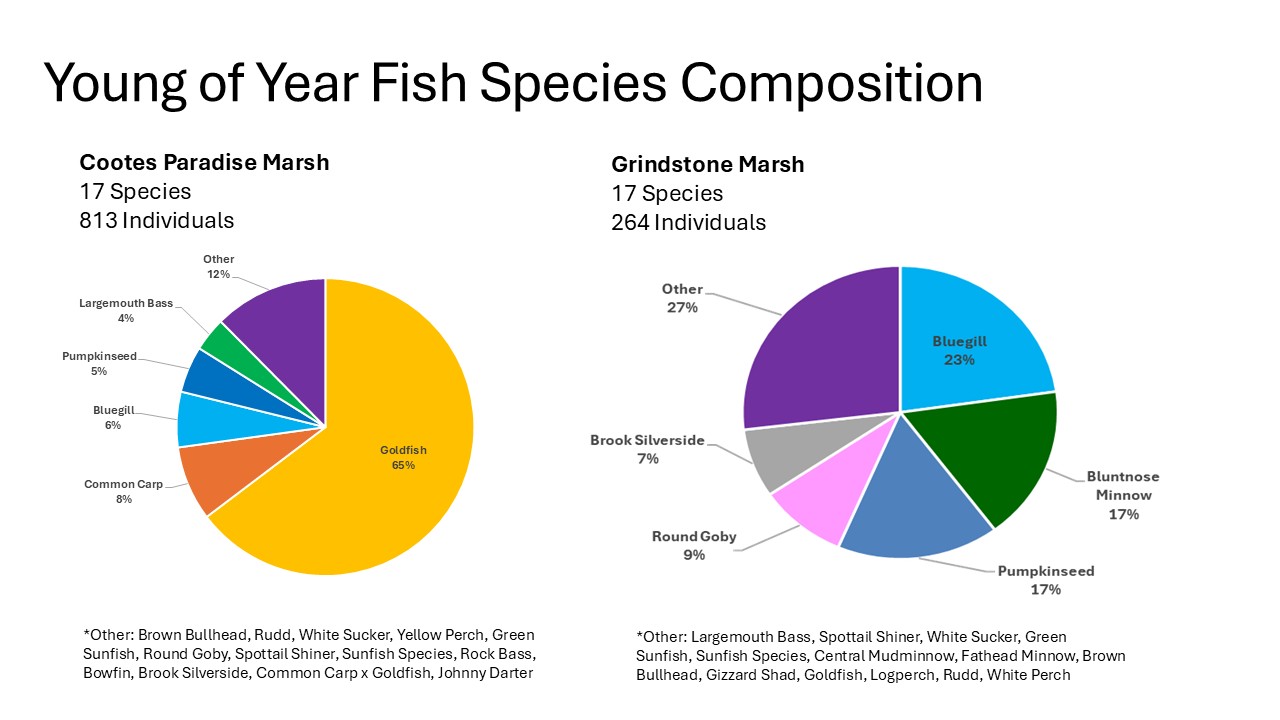
The fish communities of Grindstone Marsh and Cootes Paradise Marsh are sampled each August to determine which species successfully spawned during the season. The 2025 results were among the most striking observed in the 31 years of monitoring these marshes’. Both marshes showed relatively low fish densities, reflecting a lake-wide trend. However, the species composition differed dramatically. Grindstone Marsh was dominated by native species such as sunfish, while Cootes Paradise was dominated by introduced Eurasian species, particularly Goldfish (see graphs below). Even with lower densities, these marshes still produced several million young fish in 2025—although this represents a reduction from the tens of millions produced in some previous years.
What explains the difference between these two marshes? The primary factor is water quality, particularly which species can survive environmental extremes such as seasonal oxygen depletion caused by organic decay and excess nutrients. Other pressures include disease and pollutants. Cootes Paradise continues to receive both treated and untreated sewage inputs, while the last known major sewage discharges into Grindstone Marsh ended in 2011. These conditions strongly influence fish survival and community composition. Water quality monitoring continues to document periods of near-zero oxygen during summer in Cootes Paradise. As a result, the species that succeed there are those capable of tolerating such conditions. Goldfish are particularly well adapted to low-oxygen environments and have become dominant. Other species with similar tolerance include Common Carp, Bowfin, Gar, several catfish species, and Northern Pike. Unlike carp, however, Goldfish are relatively small and do provide some ecological value as prey, supporting predators such as bass, pike, herons, terns, and eagles.
Addressing the sewage issue remains a priority of the Hamilton Harbour Remedial Action Plan (HHRAP). The primary partner implementing water quality improvements on the ground is the City of Hamilton, with major efforts focused on the Dundas wastewater plant and reducing the sewer overflows. Several targeted sewer infrastructure projects are currently underway. Recently, two significant sewer overflow capture projects were completed at the Glen Road overflow (to Chedoke Creek) and Sterling Street overflow (to Westdale Creek). These projects substantially reduce sewage spills, limiting them to only the most extreme storm events.


Photos from the first Fishway lifts of the 2026 season.
More from the RBG Blog
Check out RBG’s blog for announcements, articles, and more from Canada’s largest botanical garden.
Want to be sure you hear first? Sign up for our weekly e-newsletter to hear about upcoming events, weekend activities, articles, and more!
