




| Membership | Price (+HST) |
|---|---|
| Single | $85/year |
| Single Plus | $120/year |
| Family | $130/year |
| Family Plus | $175/year |
| Contributing | $300/year |
| Supporting | $600/year |
| Sustaining | $1,000/year |
| Benefactor's Circle | $2,500/year |
| Director's Circle | $5,000/year |
| President's Circle | $10,000/year |

Think Savannah: Plant Native Species and Rebuild Grasslands
April 21, 2026
By Tys Theijsmeijer, Senior Director of Ecosystem Stewardship Programs and Policy
Earth Day is a reminder that our health and wellbeing are deeply connected to the sustainability of the planet. Earth Day is intended to inspire positive choices—whether that’s learning about an environmental issue, participating in activities like litter cleanups or tree plantings, or making changes at home that benefit both community and environment. Spring is a particularly timely season for action. It’s when accumulated winter litter becomes visible along fence lines and ditches, and when the landscape itself signals renewal. It’s also an ideal time to think about planting—especially when we consider habitats that are often overlooked, like grasslands and savannahs and the wildlife that depend on them.
For spring 2026, consider planting species associated with grassland and savannah habitats—ecosystems defined by open, sunny conditions with few trees. Native shrub and small tree options that support these diminishing habitats in Ontario include American Plum (Prunus americana), Sweet Crabapple (Malus coronaria) and Hawthorne (Crataegus spp.) all of which provide tasty fruit. For the tree side, perhaps the more famous tree of the “Oak Savannah’”, the Black Oak (Quercus velutina). Grasslands and savannahs are of course mostly grass and wildflowers. For planting these top choices include bluestem and rye grass species, and wildflowers like coneflower species, Wild Bergamot, Wild Penstemon and the brilliant orange Butterfly Milkweed. All of the above are perfectly appropriate to a sunny place in the home garden and all are a great contribution to the Earth Day theme.
Tree planting remains one of the most visible and symbolic environmental actions, with real benefits—from providing shade that cools cities in summer, to reducing erosion during intense storms, to forming the structural backbone of habitat. In the Hamilton–Burlington area, we sit within the Eastern Deciduous and Mixed Forest Region. As the climate changes, our forests are also shifting: some species are expanding northward, while others decline. Well-suited trees for current and near-future conditions include Tulip Tree, Pin Oak, and Eastern Red Cedar as well as many others. Many online resources are now available to help us see the possibilities, including a species review report by RBG in support of future tree planting and sustainability for the natural areas.
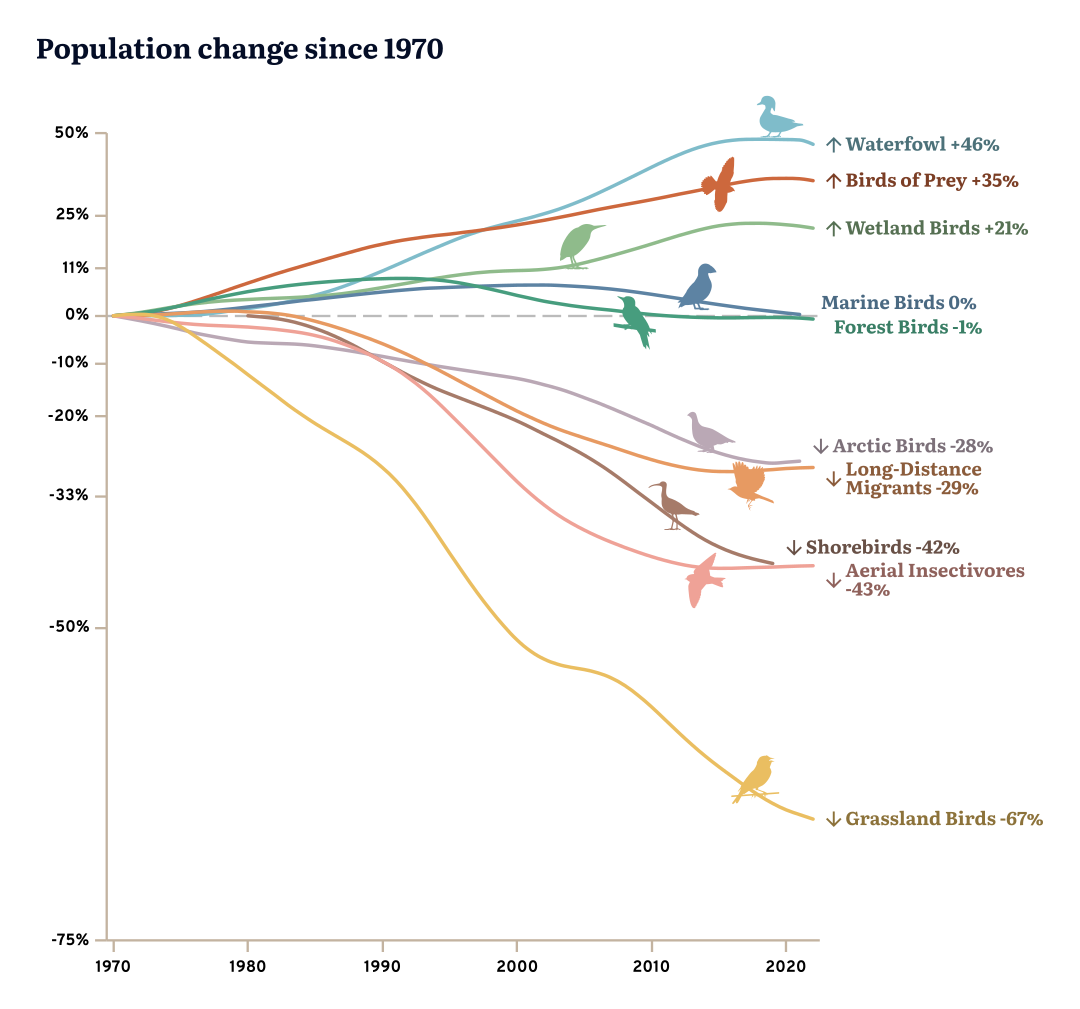
However, planting beyond trees—into shrubs, grasses, and wildflowers—is an increasingly important priority. Across Ontario, grassland habitats have been widely converted to agriculture, urban areas, or forest, leaving meadow ecosystems underrepresented in conservation efforts. As a result, grassland birds are now among the most rapidly declining groups in Canada, as highlighted in the State of Canada’s Birds report..
At Royal Botanical Gardens, efforts are underway to address this gap. Approximately 50 hectares have been dedicated to meadow restoration as a key stewardship priority, with early status reports on progress now available for sites such as the Berry Tract. After several years of restoration, former agricultural fields are transitioning into native plant-dominated meadows. These habitats are functioning and improving, but they also reflect the broader regional decline in grassland bird species.
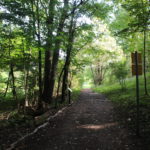
You can visit two of these sites including the Rock Chapel meadow areas as well as Princess Pt via the RBG nature trail system. The RBG Arboretum is also undergoing a gradual transition to a more savannah-like environment. For reference, a savannah is a form of meadow/grassland with low levels of trees and shrubs (ie less than 35% canopy coverage). Planting these species at home creates opportunities for native plants to expand into surrounding natural areas, as seeds disperse and establish where conditions are suitable. With many resources now available to guide species selection, small actions at home can contribute to broader ecological recovery.
More from the RBG Blog
Check out RBG’s blog for announcements, articles, and more from Canada’s largest botanical garden.
Want to be sure you hear first? Sign up for our weekly e-newsletter to hear about upcoming events, weekend activities, articles, and more!
