






| Membership | Price (+HST) |
|---|---|
| Single | $85/year |
| Single Plus | $120/year |
| Family | $130/year |
| Family Plus | $175/year |
| Contributing | $300/year |
| Supporting | $600/year |
| Sustaining | $1,000/year |
| Benefactor's Circle | $2,500/year |
| Director's Circle | $5,000/year |
| President's Circle | $10,000/year |


Magnolia

Magnolia Collection
Peak Interest: Late April, Early May
Arboretum, Rock Garden
These big, beautiful trees feature iconic cup-shaped blooms in white, pink, purple and yellow.
RBG’s magnolia collection reaches peak bloom anywhere between April and May given the type of climatic conditions per year. These plants produce spectacular flowers in a range of colours including white and cream through to pale to deep pink, purple, rose and less commonly soft yellows. Many are fragrant. Check out the species and cultivars of Magnolia salicifolia which have a very unusual licorice type fragrance. The magnolias on the western side of the Arboretum are a memorial to Lester Husband a local architect whilst the eastern collection is a memorial to R.A. Sims a past member of RBG staff.
- Please respect the trees.
- Don’t break off blooms, shake the branches, or climb the trees as you can damage or break the tree branches.
- Use of drones is prohibited under RBG bylaw and further regulated by NavCanada.
Magnolia Bloom Watch
Check back for updates as our Star and Saucer Magnolia come into bloom
Current status: The magnolia collection has now finished blooming for the season.


Plan Your Visit to the Magnolias
The largest and oldest collection of both Star and Saucer magnolia trees can be found at RBG’s Arboretum (16 Old Guelph Road, Hamilton).
Admission is not required to access the Arboretum; parking fees apply.
Open 9 a.m. to 8 p.m.
Until May 8, parking at the Arboretum is available to all first-come, first served. Weekend shuttle available from RBG Centre (680 Plains Road W., Burlington).
Non-Members:
- Weekdays: Pay a flat $25 parking fee using the machine upon entry (card only)
- Weekends 9 a.m. to 5 p.m.:
- Pay a flat $25 parking fee using the machine upon entry (card only) OR pre-book your shuttle tickets ($10), park at RBG Centre (680 Plains Rd. W. Burlington)
- Weekends, 5 to 8 p.m.: Pay a flat $25 parking fee using the machine upon entry (card only)
Admission is not required to access the Arboretum; parking fees OR shuttle ticket apply.
Members:
- Weekdays & Weekends: simply scan your member parking card upon entering and exiting
- May 2 & 3 Weekend Overflow Shuttle: Pre-book your free shuttle tickets, park at RBG Centre (680 Plains Rd. W. Burlington)
NOTE: your parking card is required for all Arboretum visits (tap to enter and exit). Members arriving without this card will be required to pay the parking fee.
The Arboretum is home to many flowering tree collections, including Magnolias, Crabapples, and Lilacs which typically bloom in May. Find out what’s in bloom before your visit.
Parking capacity at the Arboretum is very limited. To best accommodate increased weekend visitation, on-site parking is reserved for RBG Members only. All other visitors can take advantage of the shuttle service from RBG Centre on weekends.
Reservations are required for weekend visits between May 9 and 24, 2026 for both RBG Members and Shuttle from RBG Centre.
Non-Members:
- Weekdays: Park at the Arboretum. Pay a flat $25 parking fee using the parking machines upon entry (card only)
- Weekends 9 a.m. to 5 p.m.: Pre-book your shuttle tickets, park at RBG Centre (680 Plains Rd. W. Burlington)
- Weekends, 5 to 8 p.m.: Pay a flat $25 parking fee using the parking machines upon entry (card only)
Members:
- Weekdays: simply scan your member parking card upon entering and exiting
- Weekends 9 a.m. to 5 p.m.: Member-exclusive parking, make your reservation online + scan your member parking card upon entering and exiting
- Weekends, 5 to 8 p.m.: simply scan your member parking card upon entering and exiting
NOTE: your parking card is required for all Arboretum visits (tap to enter and exit). Members arriving without this card will be required to pay the parking fee.
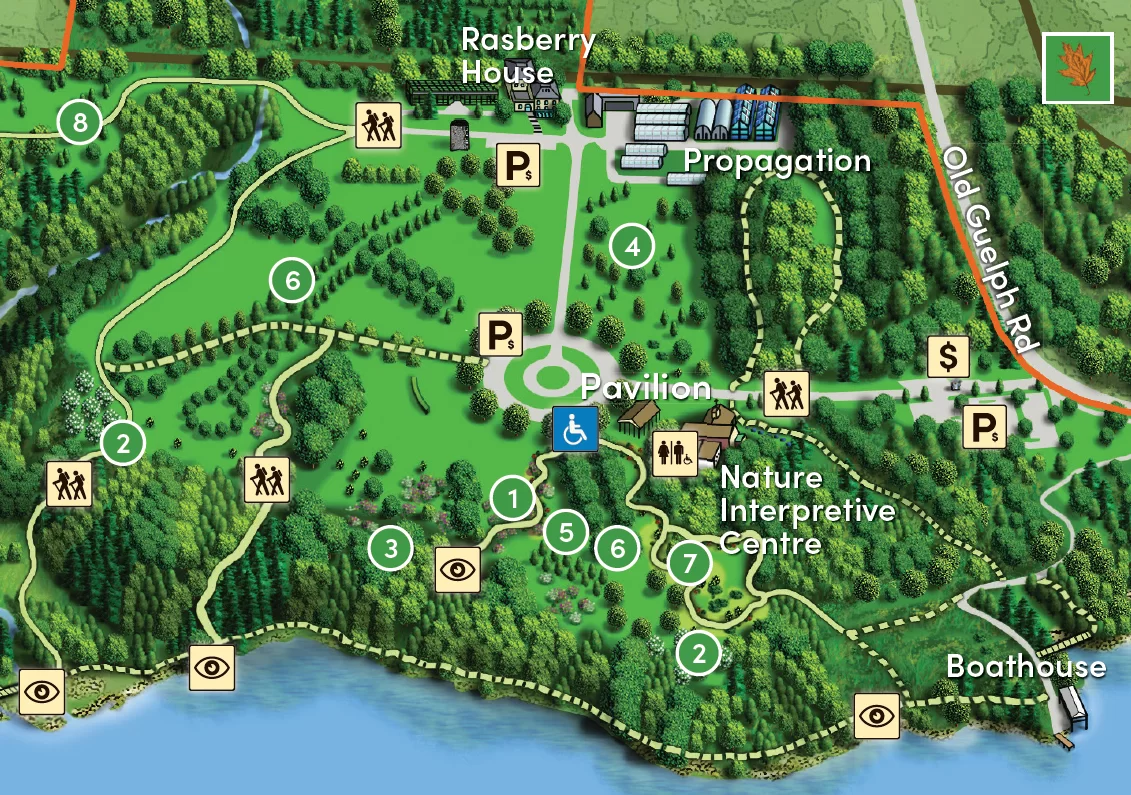
The Arboretum is home to two magnolia collections. Star Magnolia (early bloomers) can be found on the western portion of the Arboretum, while the Saucer Magnolia are located in the Southern portion of the Arboretum. See the #2 locations on the map below.
Other Locations
Individual and small groupings of trees are also located in Rock Garden, Laking Garden, and Hendrie Park/RBG Centre.
Rock Garden
1185 York Boulevard, Hamilton
Find a select number of trees throughout RBG’s oldest garden!
Admission: Garden admission applies. Free with RBG Membership.
Parking: FREE, available on site
Hendrie Park / RBG Centre
680 Plains Road W. Burlington ON
Find saucer magnolia trees outside RBG Centre, in Global Garden, and the Woodland Garden.
Admission: Garden admission applies. Free with RBG Membership.
Parking: FREE, available on-site
RBG’s Prestigious Magnolia Collection
Within RBG’s collection many of the magnolias displayed have gained the prestigious Royal Horticultural Society‘s Award of Garden Merit. This is a mark of quality awarded to garden plants of superior quality and performance. Magnolia cultivars include ‘Brozzonii’, ‘Elizabeth’, ‘Galaxy’, ‘Leonard Messel’, ‘Merrill’, ‘Rustica Rubra’ and ‘Wada’s Memory’.
What’s in Bloom?
Blooms are ever-changing in RBG’s five cultivated garden areas and nature sanctuaries. Check back to learn what’s blooming now or see the blooms calendar for a rough estimation of what to expect in a particular season.
About Magnolias
The genus magnolia is fascinating. Here a few fascinating facts about this beautiful spring flowering plant.
Conditions and Care
Magnolia are deciduous or evergreen trees or shrubs, with large showy, often fragrant flowers. The flowers usually open in spring before the leaves and are often followed by colourful cone-like fruit. The leaves, more often than not, are large and oval in shape. A location with full sun or partial shade is ideal along with soil that is organically rich, moist but well drained. Most magnolias prefer to be planted in areas that avoid strong wind and frosts as in severe years the latter can cause damage to flower buds.
Magnolias can be intolerant of urban conditions but a particular cultivar, ‘Galaxy’ has been planted as a demonstration street tree in the RBG Centre parking lot. Aside from some drought stress symptoms in 2012 and 2013 this cultivar seems to tolerate these conditions. Magnolias can be planted en masse for spectacular effect or equally can be planted in a bed, border or lawn as a specimen plant. Many cultivars are available at your local garden centre and once planted these plants will reward you for years to come.
Magnolia Genus
Magnolia is a large genus thought to currently consist of around 240 naturally occurring species in the wild. The primary natural range of Magnolia species is in east and southeast Asia with a secondary centre in eastern North America, Central America, the West Indies, and some species in South America. This is termed a disjunct distribution meaning plants are separated geographically over diverse locations. This could be caused by range fragmentation including continental drift, mountain building or changes in sea level or by habitat fragmentation including population disruption, isolation of populations or even extinction.
131 species are currently threatened with extinction and of those 89 are endangered or critically endangered. The conservation of magnolias and other plant species is one of the reasons that makes the work of botanical gardens so critical for the future of the planet. Look out for Magnolia acuminata (Cucumber Tree) which is Ontario’s own native magnolia and is displayed in RBG’s collection.
Cultivars and Hybrids
In a horticultural setting magnolia are a highly desirable genus and much loved plant. Because of this popularity over 1000 cultivars (cultivated varieties) have been bred by magnolia hybridisers and enthusiasts and more appear every year. Much work has been spent on trying to introduce new varieties with flowers that display elusive and more unusual colours. Soft yellow in recent years has become a highly desirable flower colour In RBG’s collection look out for Magnolia ‘Butterflies’ and Magnolia × brooklynensis ‘Yellow Bird’ to see these spectacular flowers in shades of yellow.
History of Magnolias
Whilst the flowers of magnolias are considered to be some of the most spectacular of spring flowering plants they are also amongst the most primitive of flowering plants. It is thought that the flowers evolved to encourage beetle pollination which appeared much earlier than more modern insects such as bees. This pollination mechanism is the reason that magnolia flowers are so large and sturdy.
The genus Magnolia was named to honour the French botanist Pierre Magnol (1638 – 1715). Magnol is of lasting botanical importance as he was one of the innovators of the current botanical scheme of classification. He was the first to publish the concept of plant families, a natural classification, in which groups of plants with associated common features were described.
Plant Uses
Whilst many magnolias are planted purely for their beauty in gardens around the world some species also have additional uses. The exploitation of plants by people is called economic botany. Economic botany explores the ways humans use plants for food, shelter, medicines, textiles, and much more. Ontario’s own species, Magnolia acuminata grows to a very large size and so is harvested as a timber tree in eastern North America.



Support Horticulture at RBG
The care and growth of our horticultural collections are possible thanks to the generous support of RBG Members and donors. With a donation to Royal Botanical Gardens, you can ensure an active, vibrant and healthy future for the children of today and tomorrow through our horticultural and conservation projects.
Royal Botanical Gardens (RBG) is the largest botanical garden in Canada, a National Historic Site, and registered charitable organization with a mandate to bring together people, plants and nature.
More to See, Naturally
Other Major Collections
As a botanical garden, Royal Botanical Gardens acquires, collects, researches, exhibits, conserves and interprets a living horticultural collection.
Bloom Calendar
Plants of interest are ever-changing in RBG’s five cultivated garden areas and nature sanctuaries. Check back to learn what’s blooming now or see the blooms calendar for a rough estimation of what to expect each season.
Events Calendar
Discover what’s happening in the gardens! Some programs, events, and experiences listed below are included in general admission / membership, while others require separate registration.
